

|
|
The Program for Leadership
Education
Overview
Required Leadership Courses and Experiences
Leadership Focus for Further Leadership Development
Executive Education
Doctoral Program
Overview
We are deeply committed to the notion that learning to become a leader requires a combination of theoretical knowledge and applied skills. Our curriculum and learning opportunities are structured to deliver an innovative, invigorating and challenging mixture of these.
Our performance-learning approach to education distinguishes us from our peers. While many schools provide hands-on experience such as internships and project work, we provide intensive preparation and a theoretical framework in advance of these, and require students to deliver results, while providing them with continuous expert feedback.
As a result, employers report that our students stand out among other MBA interns, and are well and thoughtfully prepared to take on significant levels of responsibility in the jobs they enter upon completion of their degrees.
As we help our students to grow as leaders, the merit of our approach has been repeatedly proven. Students not only learn our leadership model but apply it to themselves, practice and refine their skills in multiple venues, receive abundant feedback, and make improvement a personal habit.
Since the Johnson School MBA is designed to provide a highly flexible experience that enables students to grow and develop in ways most important to them individually, we provide varied ways for them to learn about leadership, management, and organizations.
- All students are required to undergo a set of courses and experiences designed to provide them with a theoretical understanding of leadership and analytical thinking and to apply these concepts. We challenge them to identify their own strengths and opportunities for growth and improvement, and provide them with multiple venues to address these throughout their tenure at the Johnson School.
- For students who want to pursue further individual leadership development, we offer the Leadership Focus, a flexible curriculum providing both theory and practice.
- Our Leadership Skills Program provides a menu of short workshops and courses focused on specific topics.
- We select a small cadre of second-year students to become Leadership Fellows. These individuals assist faculty in providing feedback and help to first-year students, while practicing their own leadership skills.
Required Leadership Courses and Experiences
For All MBA Candidates
All Johnson School MBA candidates undergo two core leadership courses and an experiential weekend program when they enter the school.
- Our Foundations in Leadership course is the centerpiece of our MBA orientation curriculum. It is designed to help students assess and understand their strengths and improvement opportunities in leadership and management.
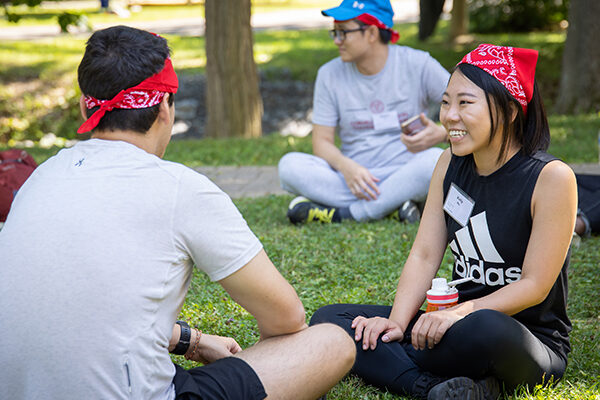
- In addition, the Johnson Outdoor Experience provides experiential leadership and team building at a weekend orientation event held at a nearby lake. Second-year students plan and organize the weekend and are trained to facilitate the events.
- Our Analytical Thinking Thread, taught during orientation, builds on what students learn during Foundations in Leadership. Analytical thinking is one of the most critical skills for leaders to possess, yet most business schools do not address it directly. In this course, groups of 20 students practice analyzing cases on the spot. The sessions stress deep and broad analysis, as well as the ability to "stand and deliver" through argument and persuasion.
Leadership Focus
For Further Leadership Development
For students who choose to focus on developing their leadership potential, we offer the Johnson School Leadership Focus. This 10-credit-hour program is comprised of common and flexible components, all based on the Johnson School Leadership Model. The common component is a shared experience that participants undertake as a cohort. The Leadership Focus addresses particularly the Action and Personal Mastery learning strategies of the model. It begins with Goal Setting and Coaching for Leadership Success (NBA 672), and draws heavily on the leadership assessment components of the Foundations in Leadership course.
The flexible component is a menu of course options (including standard and experiential courses, as well as Leadership Skills Program workshops.) Through the flexible component, students can customize the Johnson School Leadership Focus to meet their individual development needs.
Leadership Courses
- Business Ethics (NBA 671)
- Consulting Process (NBA 578)
- Critical Thinking in Business (NBA 588)
- Goal Setting and Coaching for Leadership Success (NBA 672)
- Inclusive Leadership (NBA 538)
- Insights into Technical Leadership (NBA 597)
- Leadership in Management (NBA 570)
- Leadership Theory and Practice (NBA 515)
- Leading Teams and Organizations (NBA 668)
- Managerial Decision Making (NBA 663)
- Management of Technology and Innovation (NBA 665)
- Negotiations (NBA 666)
- Sustainable Global Enterprise (NBA 603)
- Perspectives on Leadership (NBA 670)
Leadership Courses for Students Outside Johnson School
Managing and Leading in Organizations (NCC 554)
The capstone of the Foundations in Leadership course is an immersion in the Johnson School Business Simulation. This business simulation is an intensive, 1 ? day exercise, in which students work with a team to compete against other "firms" in their industry. Decision quality, team process, and performance are measured according to the Johnson School Leadership Model.
Leadership Skills Program
The Leadership Skills Program is designed to assist MBA students in developing managerial and leadership skills outside of the traditional business school curriculum. The LSP workshops complement and enhance the Johnson School's established courses, but more importantly, help students refine the skills required to succeed in the business world.
The novel, informative, and challenging workshops are led by world-class business leaders, professional trainers, faculty and staff from the Johnson School, and faculty and staff from other units at Cornell.
LSP workshops cover four skill areas: leadership and teams, communications, personal skills, and quantitative and analytical skills. All LSP courses are electives. MBA candidates may enroll in as many workshops as they like, but may apply only up to 1.5 credit hours from them toward degree credit hour requirements. Each LSP workshop is taught on a single day, and may run from three to eight hours.
LSP Programs are generally open only to Johnson School MBA candidates. Registration for courses is accomplished through a bidding process.
The list of LSP workshops accessed here is typical. The actual list of courses, and instructions for the bidding process, are available to all registered Johnson School MBA students through Blackboard.
Team Fellows
This elite group of 14-18 second-year students is selected for their analytical and leadership skills. Their job is to assist the Analytical Thinking Thread faculty leaders in providing feedback to the 1st year students on analytical ability, and to assist the first-year students in navigating the core curriculum, working in study groups, and provide peer coaching and leadership. In this way, the fellows not only provide meaningful assistance to first-year students, but in the process, also practice their own leadership skills.
Executive Education
The Johnson School provides executives with the opportunity to learn cutting-edge thinking on topics of importance. Several intensive week-long seminars are offered annually. In addition, we tailor executive education for the specific needs of organizations. More?
Doctoral Program
The Management and Organization faculty aims to prepare first-rate scholars of management who will continue to advance the world's knowledge base as faculty members of top business schools. Our Doctoral Student Handbook for Management and Organizations provides some fundamental information about our research interests, expectations for doctoral candidates, and the systems and support structures available to them.