

2007 Headlines
Value Investing -Making Money in the Age of Turbulence
Mihir Sheth MBA '09
Can one make money in today's turbulent financial markets? Should one relish the thought of waking up in a down market and going out there to make investments? What's the secret behind managing a fund that has had only one money-losing year since inception in 1983?
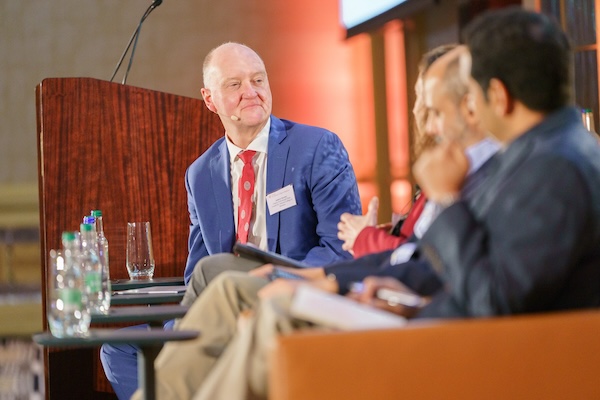
We had the pleasure of learning more about the above questions and many more insights from Seth Klarman, CU '79, chairman of The Baupost Group last week. He delivered a lecture on the topic of "Value Investing - Margin of Safety" at an event co-sponsored by the Johnson School and the undergraduate Department of Applied Economics & Management.
Mr. Klarman set the stage by briefly highlighting the pressures that investors face in light of the recent problems in the financial markets. First, investors face "real" pressure from their clients and their clients' investment consultants to deliver return. Second, investors also face "managing" pressure on account of the manager's own "adrenaline, ego and fear" to deliver short term performance. He highlighted that it is a combination of these pressures that force investors to sacrifice long-term strategies to pursue short-term performance.
The other phenomenon that has been forcing excessive risk taking in today's financial markets is the endless search for alpha. On this issue, Mr. Klarman said that the "best investors do not target return, they target first risk and then decide whether the projected return justifies taking the risk." Indeed, it is this philosophy that has served The Baupost Group well and helped its record of having only one down year over the past twenty-five years.
In today's environment where the "bad news is on the front pages," value investing, the strategy of buying stocks at an appreciable discount from the value of the underlying businesses, provides the roadmap to navigate through both good and bad times. This strategy of buying at a discount, Mr. Klarman explained, helps create a margin of safety for the investor - creating room for "imprecision, error, bad luck and the vicissitudes of falling markets and economies."
Mr. Klarman shared with us a humorous anecdote from his friend and value investor - Chris Browne, chairman of Tweedy, Browne Company, LLC. Mr. Browne was interviewing a trader and walked him past their trading floors. After the interview, the trader commented that at most Wall Street firms if you pass by the trading floor you can know if the market is up or down. At Tweedy Browne, you can't even tell if the market is open! Through this story, Mr. Klarman highlighted the difference between today's short-term, decision-a-minute investors and a truly long-term value investor.
Through the rest of the lecture, Mr. Klarman explained in further detail how reality in financial markets tends to diverge significantly from theory, especially with regards to the efficient market hypothesis, the perils of using leverage for investing activities, how value investing is different from speculation, and how it falls between economics and psychology. He also explained how institutional constraints and market inefficiencies provide opportunities for value investors even if one assumes that markets are efficient.
Click here to access the full video of Mr. Klarman's presentation.